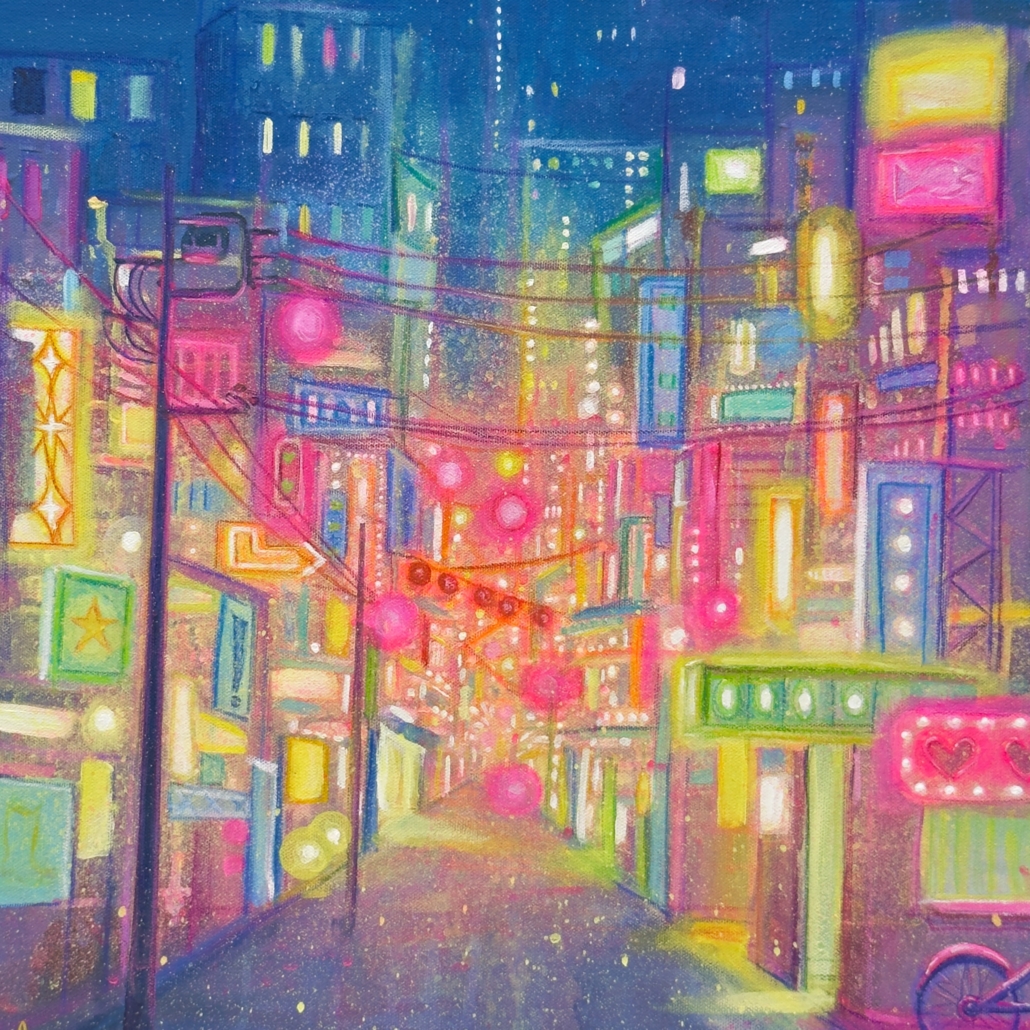
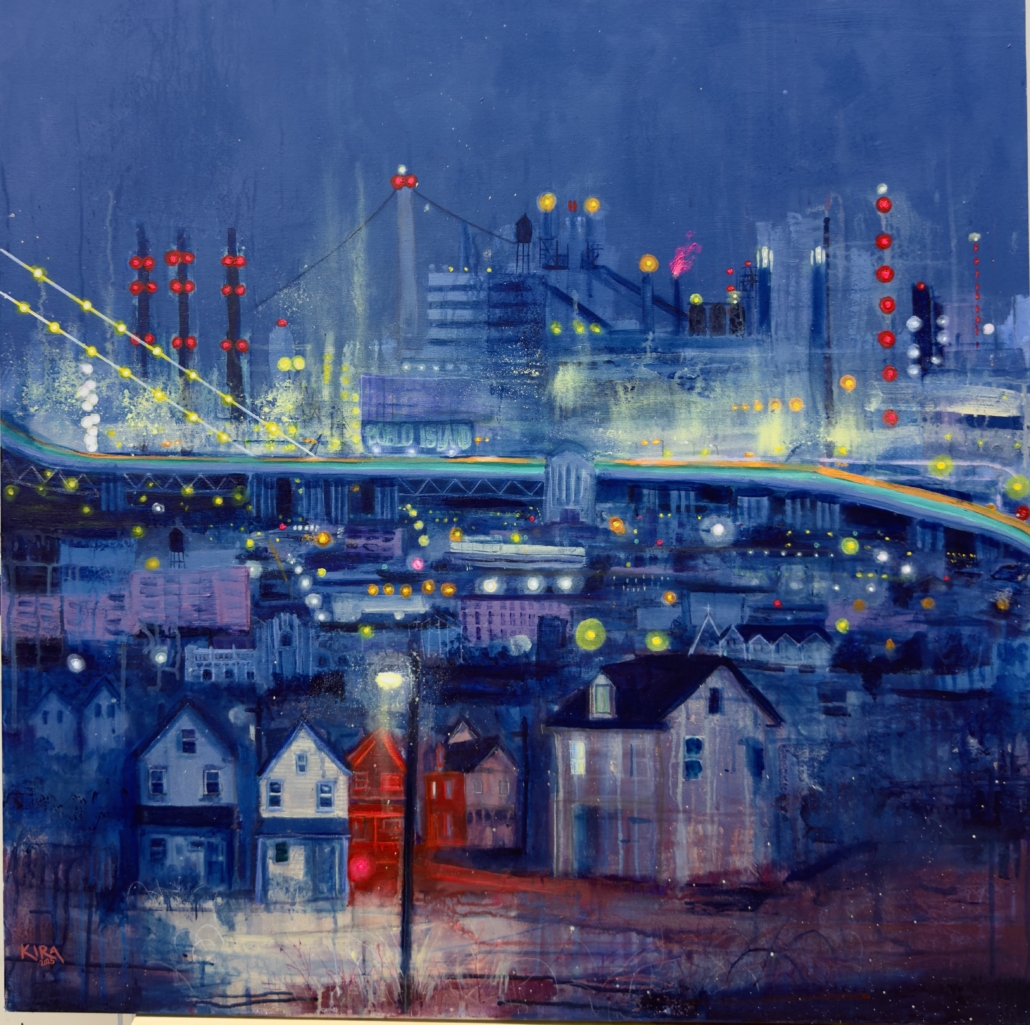
Walk through any large city and inevitably you will find a place so filled with shimmering lights and color as to make a medieval monk weep. We are of course, not generally so moved emotionally by the sight. If we could strip away all of the crass messages of capitalism and see with the pre-literate eyes of a child, perhaps we could see how the night shines. These colors sparkle like a stained glass cathedral, but they offer no messages of salvation, only salivation.
In the Studio:
This painting was challenging due to the depictions of neon lights, and all of the lights collecting together. Many times through the process I would add another glaze of color thinking it would be sufficient, only to find it still was not as bold as I wanted. There was a push and pull between adding enough darkness to let the light shine and having enough light to depict my vision. Careful use of many techniques including some sprayed paint come together for this symphony of color.
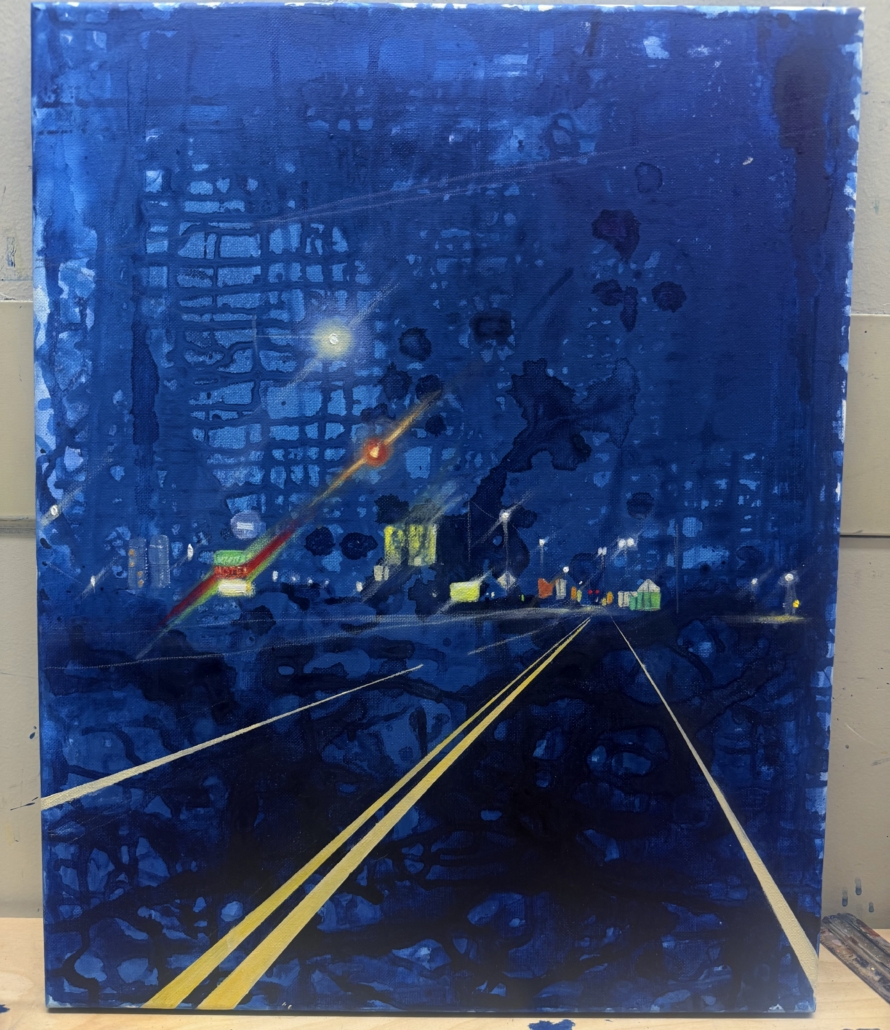
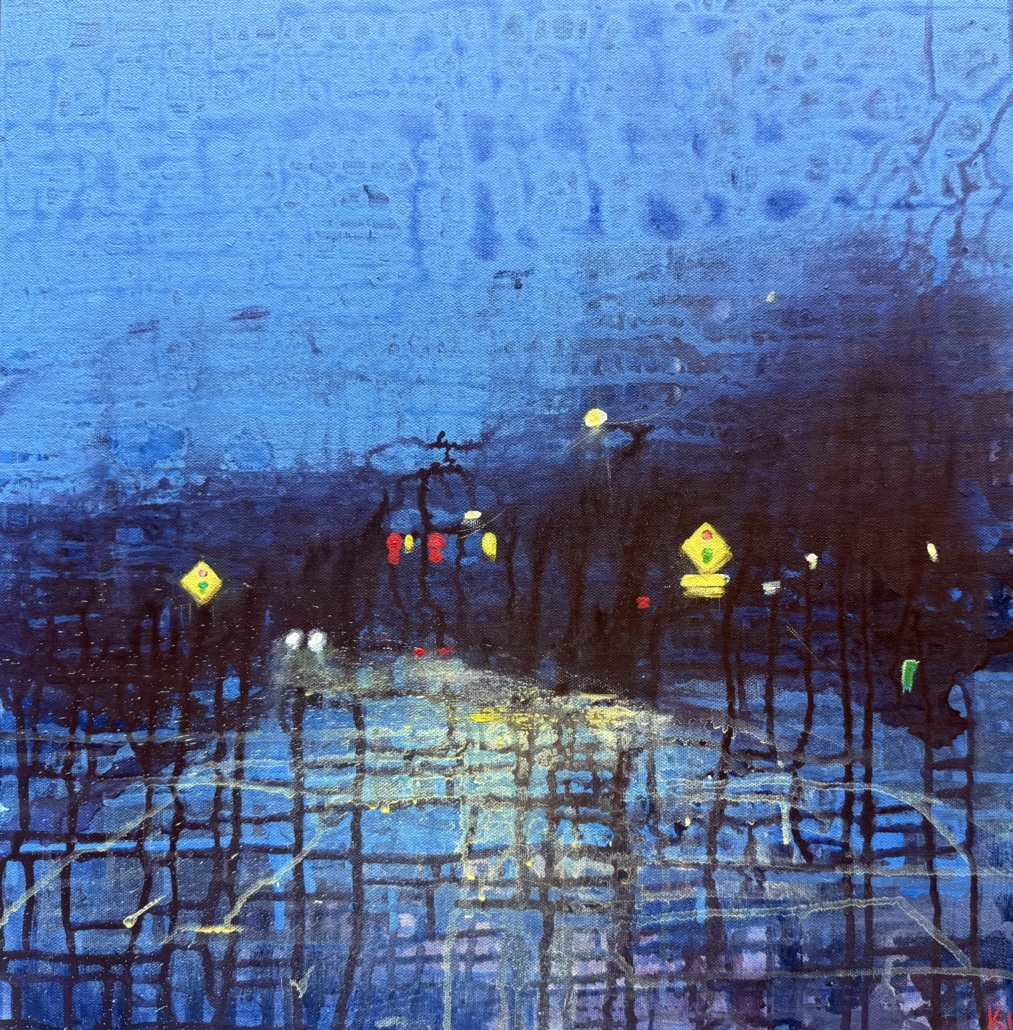
This series of paintings was inspired by the feeling of driving home after a long day. Coming home from the day’s activities, tired, warm, letting the scenery pass you by as if in a dream. Conceptually, the road represents our journey in life. The hero must face the path ahead and rise to meet any challenge in his path, yet after all the experiences that he gains from his journey, he has not truly won the battle until he returns home.
In the Studio:
This series used some techniques that I had not previously been employing on my canvas art, but was familiar from my work with watercolor. I have several spray bottles of water that I use in varying ways. I have a tiny bottle, which can put out a fine mist, leaving the paint mostly undisturbed. I have a large spray bottle for larger amounts of water output, or for creating a droplet effect, and I have a bottle with added wetting agent. Additionally I use squeeze bottles, droppers, and more to apply diluted paint to the canvas. I work in many, many layers. I add paint, sometimes selectively and sometimes allowing it to simply do what it will. This allows me to achieve a great deal of interesting texture and a sense of flow. The pigments in the mixed paint colors do not always behave the same way, occasionally creating striations and swirls of color as they dry.
Once I am satisfied with the background of the painting I spend time simply observing it. I look at the way the colors have created a burgeoning composition. Sometimes I do a sketch onto tracing paper, or sometimes I simply begin. I carefully observe the colors and details of the images I use for references, taking elements from several usually to create my final piece.
https://kiratstudio.com/wp-content/uploads/2025/07/IMG_0328-edited-scaled.jpeg2560251768793pwpadminhttps://kiratstudio.com/wp-content/uploads/2025/07/kt-logo-lg-263x300.png68793pwpadmin2025-07-21 16:35:382025-08-01 16:51:15Night Drive Series
The American Highway System and Its Artistic Legacy
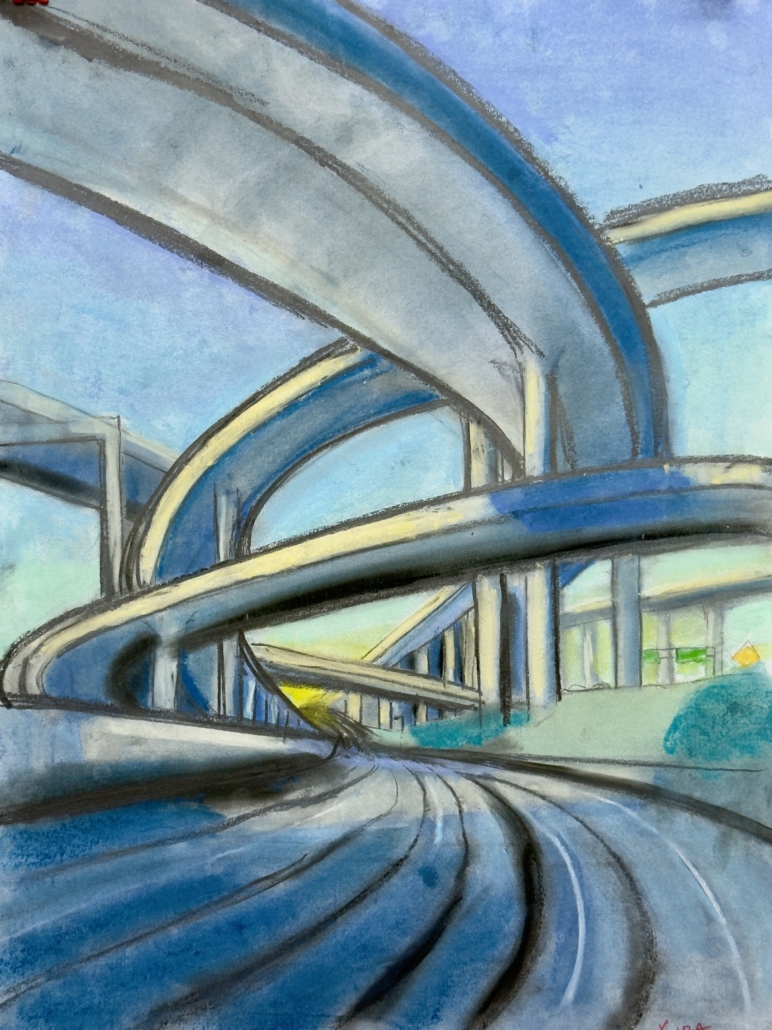
The American highway system, a vast network of roads stretching across the nation, has long been more than a means of transportation. It is a symbol of progress, mobility, and the evolving American landscape. From the iconic Route 66 to the modern interstates, these highways have become powerful subjects for artists seeking to explore themes of industrialization, nostalgia, and cultural transformation.
Highways as a Canvas for Artistic Expression
The highways of America have inspired artists to reflect on the intersection of industry, nature, and society. The roadside, with its aging billboards, industrial ruins, and deserted motels, serves as a potent symbol of the country’s historical and cultural shifts. For many artists, these sites represent the beauty and decay of an industrialized America, offering a nuanced view of both progress and decline.
The industrial landscape of the Rust Belt, with its decaying factories and weathered infrastructure, is particularly evocative. Artists use these scenes to explore the contrast between human-made structures and the natural environment, often portraying a sense of nostalgia for a bygone era while confronting the harsh realities of urban decay.
Modern Artistic Interpretations
Today, artists continue to use the highway system as a metaphor for the passage of time and societal change. Acrylic paintings, photography, and mixed media works frequently focus on the texture of crumbling concrete, rusted metal, and overgrown landscapes, capturing the tension between the constructed world and the natural one. These pieces often address broader themes such as environmental impact, social transformation, and the evolution of American identity.
The visual language of the American highway—its expansiveness and wear—invites reflection on the country’s industrial past, while questioning its future trajectory. Through their work, artists challenge viewers to consider the consequences of rapid urbanization, the erosion of the natural world, and the fading allure of Americana.
The American highway system is more than just a network of roads; it is a canvas on which artists have chronicled the complexities of American life. From industrial decline to cultural nostalgia, the highways offer a rich landscape for creative exploration. As symbols of both progress and decay, they continue to inspire artists in their quest to capture the ever-evolving American experience. American highway system, industrial art, Rust Belt, American landscape, contemporary art, nostalgia, urban decay, highway art, Americana.
https://kiratstudio.com/wp-content/uploads/2025/05/IMG_7996-1-scaled.jpeg2560192068793pwpadminhttps://kiratstudio.com/wp-content/uploads/2025/07/kt-logo-lg-263x300.png68793pwpadmin2025-05-05 21:28:362025-08-01 16:53:16The Free Way
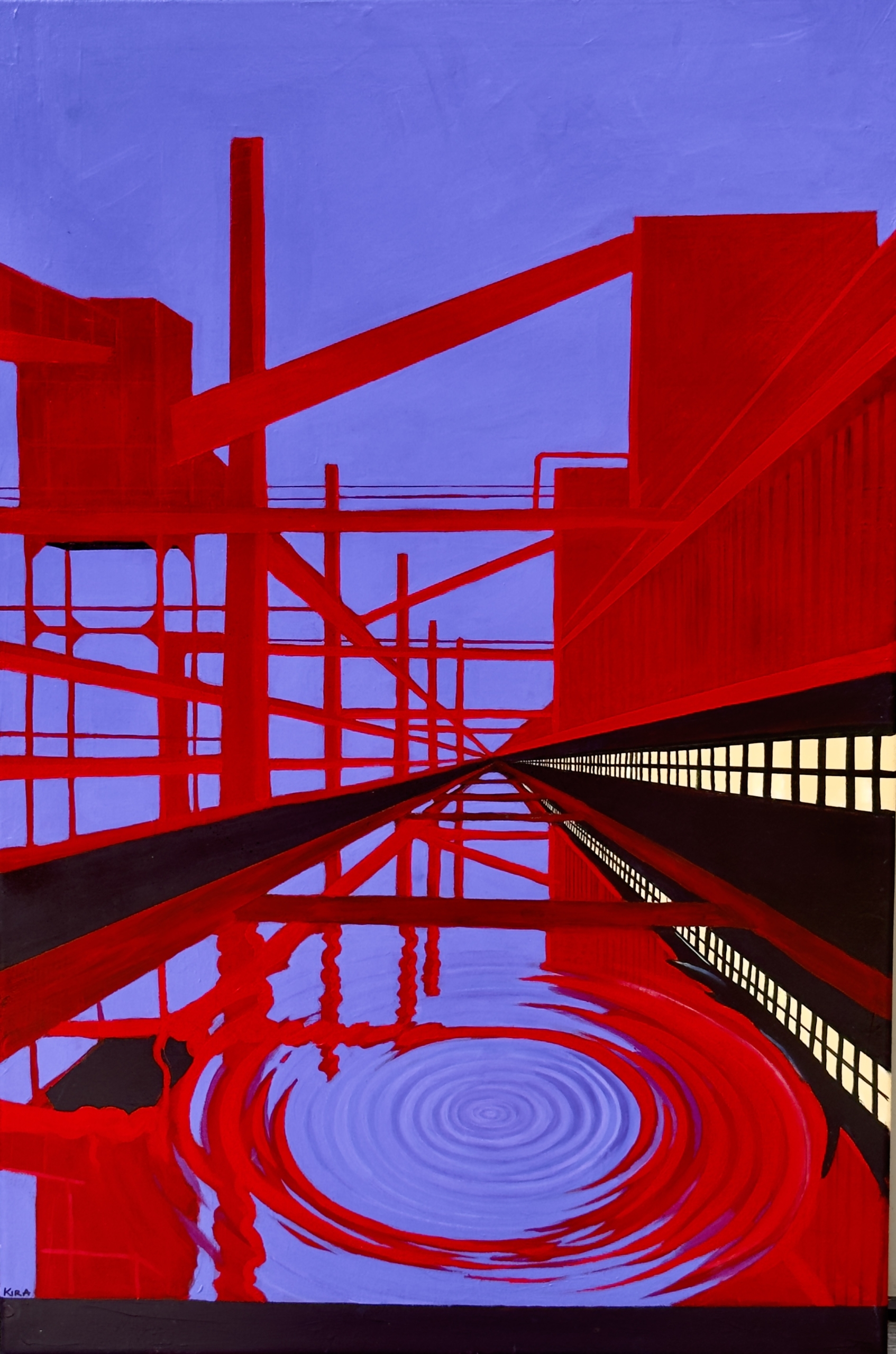
This painting is a tribute to the architecture of American industry—its sharp lines, towering structures, and the haunting beauty it leaves behind. I wanted to capture the feeling of standing in a place where machines once roared, now silent but still full of presence.
The bold red forms stretch across the canvas like scaffolding from a memory, intersecting and overlapping to create a sense of both structure and disorientation. The cool, reflective water below introduces a moment of quiet—disrupting the rigidity with a single ripple that radiates outward. That ripple became central to the piece: a symbol of impact, echo, and transformation.
Visually, the painting plays with perspective, symmetry, and light, leading the viewer down a corridor that feels both infinite and dreamlike. It’s rooted in Americana, evoking the spirit of industrial landscapes and the emotional weight they carry.
Echos is a meditation on presence and absence, order and memory. It reflects my ongoing interest in spaces that shape us, long after they’ve stopped functioning—and the beauty that lingers in their bones.
Rediscovering Americana: Painting the Beauty of Corner Stores, Gas Stations, and Motels
In a world where the ordinary is often overlooked, I’ve found inspiration in the quiet, in-between places that make up the fabric of American life. My latest painting series captures the visual poetry of Americana through vibrant, contemporary depictions of corner stores, gas stations, and roadside motels—spaces that tell stories even in stillness. These everyday landmarks are more than functional structures. They are cultural signposts, deeply rooted in memory, nostalgia, and a uniquely American sense of place. Whether it’s a sun-faded motel sign flickering at dusk or a lonely gas station glowing beneath an oversized sky, these scenes evoke a feeling of pause—what I think of as a liminal atmosphere. They exist between departure and arrival, holding the viewer in a moment of suspension.
Why Americana Still Matters in Contemporary Art
In recent years, there has been a renewed interest in Americana as both a cultural motif and an artistic subject. Artists across mediums are revisiting the visual language of mid-century architecture, vintage signage, and blue-collar infrastructure. For me, these subjects carry emotional weight. They speak to themes of resilience, transition, and forgotten beauty. As an acrylic painter, I use saturated colors and bold compositions to highlight the emotional resonance of these spaces. Rather than leaning into retro aesthetics or sentimentality, I aim to reframe them as active, vivid parts of the present. My use of color intentionally disrupts expectations, inviting the viewer to see these places with fresh eyes.
Capturing Liminal Spaces Through Acrylic Painting
The idea of liminality—the state of being between two phases—is central to this body of work. Corner stores and motels may seem like simple, utilitarian places, but they also represent moments of pause, decision, and transformation. They are not homes, yet they provide shelter. They are not destinations, yet we arrive at them. Painting these spaces allows me to explore how architecture and atmosphere shape our emotional landscapes. I am especially drawn to harsh lighting, faded textures, and unexpected color juxtapositions. These visual cues hint at stories untold and time paused, creating a narrative that is both specific and universal.
Celebrating the Rust Belt and the American Roadside
Much of my inspiration comes from the post-industrial American Rust Belt—a region rich with visual contradictions. Cracked parking lots, weathered façades, and fluorescent signs all serve as starting points for a deeper conversation about place, memory, and change. By focusing on these spaces, I hope to elevate their overlooked beauty and document their place in a changing cultural landscape. This series is both a tribute and an inquiry. What do these places say about us? What remains when the crowds move on, when the cars drive past? In painting them, I ask the viewer to stop, to look again, and to find meaning in what was almost missed.
https://kiratstudio.com/wp-content/uploads/2025/07/kt-logo-lg-263x300.png0068793pwpadminhttps://kiratstudio.com/wp-content/uploads/2025/07/kt-logo-lg-263x300.png68793pwpadmin2025-04-15 15:09:372025-07-19 19:14:04The Roadside Series
This series examines overlooked icons of Americana such as corner stores, gas stations, and motels, treating them as sites of cultural residue and quiet transformation. These spaces, often transient and peripheral, occupy a liminal position within the American landscape. They exist between points of departure and arrival, functioning as thresholds where movement pauses and time feels suspended.
I use vivid, saturated color to heighten the emotional charge embedded in these seemingly mundane locations. The brightness resists nostalgia and instead presents these structures as active elements within an evolving visual language. They appear not as static relics but as living symbols that reflect both continuity and change.
By isolating and recontextualizing these spaces, I explore the tension between familiarity and estrangement. Each painting becomes a reflection on memory, place, and the subtle architecture of everyday life. In celebrating what is often dismissed as ordinary, the work encourages a reconsideration of the American vernacular and reveals the aesthetic value embedded in its most unassuming forms.
This series examines overlooked icons of Americana such as corner stores, gas stations, and motels, treating them as sites of cultural residue and quiet transformation. These spaces, often transient and peripheral, occupy a liminal position within the American landscape. They exist between points of departure and arrival, functioning as thresholds where movement pauses and time feels suspended.
I use vivid, saturated color to heighten the emotional charge embedded in these seemingly mundane locations. The brightness resists nostalgia and instead presents these structures as active elements within an evolving visual language. They appear not as static relics but as living symbols that reflect both continuity and change.
By isolating and recontextualizing these spaces, I explore the tension between familiarity and estrangement. Each painting becomes a reflection on memory, place, and the subtle architecture of everyday life. In celebrating what is often dismissed as ordinary, the work encourages a reconsideration of the American vernacular and reveals the aesthetic value embedded in its most unassuming forms.
https://kiratstudio.com/wp-content/uploads/2025/03/IMG_5729-scaled.jpeg2560201368793pwpadminhttps://kiratstudio.com/wp-content/uploads/2025/07/kt-logo-lg-263x300.png68793pwpadmin2025-04-15 14:54:482025-08-01 16:48:05Liquor Store
This series examines overlooked icons of Americana such as corner stores, gas stations, and motels, treating them as sites of cultural residue and quiet transformation. These spaces, often transient and peripheral, occupy a liminal position within the American landscape. They exist between points of departure and arrival, functioning as thresholds where movement pauses and time feels suspended.
I use vivid, saturated color to heighten the emotional charge embedded in these seemingly mundane locations. The brightness resists nostalgia and instead presents these structures as active elements within an evolving visual language. They appear not as static relics but as living symbols that reflect both continuity and change.
By isolating and recontextualizing these spaces, I explore the tension between familiarity and estrangement. Each painting becomes a reflection on memory, place, and the subtle architecture of everyday life. In celebrating what is often dismissed as ordinary, the work encourages a reconsideration of the American vernacular and reveals the aesthetic value embedded in its most unassuming forms.
.
https://kiratstudio.com/wp-content/uploads/2025/07/kt-logo-lg-263x300.png0068793pwpadminhttps://kiratstudio.com/wp-content/uploads/2025/07/kt-logo-lg-263x300.png68793pwpadmin2025-04-15 14:52:562025-04-15 15:20:18Corner Store
This experimental mixed media piece centers on a sleek reflective vinyl monolith, embedded in an abstract industrial landscape. The mirror-like surface shifts with the viewer’s perspective, creating a play between presence and disappearance. Framed by painterly color fields, the work bridges past and present—paying homage to the American west.
This impressionistic painting is a deeply personal recollection of oil refineries seen outside Chicago during childhood. With soft, atmospheric brushstrokes and a subdued industrial palette, it captures the hazy mystery of smokestacks, steel forms, and distant heat shimmering on the horizon. “Refinery Memory” is part of a larger body of work exploring the emotional landscape of the Rust Belt through color, memory, and place.
Keywords: Chicago industrial painting, refinery artwork, Midwest landscape art, acrylic urban scene, memory-inspired painting, Rust Belt artist